
Why Chiropractors Are Adding Anti-Aging Programs to Their Practice
Somewhere between the blood pressure cuff and the adjusting table, a growing number of patients are asking some version of the same question: “Doc, how do I keep this body working for another 30 years?”
It’s not a hypothetical. People over 65 are the fastest-growing segment of the U.S. population, and some Census projections put the country on track for two 65-year-olds for every teenager within the next few decades. Your patient panel is aging along with the country, and aging patients are increasingly unwilling to accept “that’s just getting older” as a clinical answer.
Chiropractic doctors are well positioned to answer that question — not with a prescription pad, but with the diet, lifestyle, and functional guidance patients are actually asking for. A growing number of DCs are formalizing that role by adding structured anti-aging education to their practice, and it’s worth understanding why.
Adequate Nutrition Isn’t the Same as Optimal Nutrition
Most of what patients know about “healthy aging” traces back to decades-old public health guidance built around a narrow goal: preventing deficiency disease. The daily nutrient values your patients grew up with — which are now outdated — were never designed to help someone reach their genetic potential. They were designed to keep large populations out of hospital beds.
That distinction matters clinically. A patient can meet every standard nutrient benchmark on paper and still fall well short of what’s now understood as optimal nutrition — intake levels associated with delaying disease onset and extending healthy years, not just avoiding acute deficiency. For a profession already built around prevention and function rather than late-stage disease management, that’s a natural extension of the care DCs already provide.
It’s also worth asking why this gap persists: how much marketing effort goes into convincing patients that a costly, patented prescription must be superior to an inexpensive, high-quality supplement offering similar nutrients. A naturally occurring compound can’t be patented, so the incentive is to develop a branded, prescription-only version instead — and lean on the assumption that anything a physician prescribes must be the better choice.
The Uncomfortable Math on How Much Control Patients Actually Have
Ask most patients how much genetics determines aging, and they’ll likely overestimate its role. Research suggests otherwise. The research says otherwise. Estimates vary, but genetics typically accounts for somewhere in the range of 5%–35% of how a person ages — leaving diet, lifestyle, and environment responsible for most of the rest. Some gerontologists put the controllable share at 40% or higher.
That’s a meaningful opening for a chiropractic doctor. A patient who believes aging is genetically predetermined has little reason to change behavior. A patient who understands that most of the trajectory is still theirs to influence has a reason to keep showing up — and a reason to trust the practitioner who explained it to them clearly in the first place.
“Real Age” Is a Conversation Patients Already Want to Have
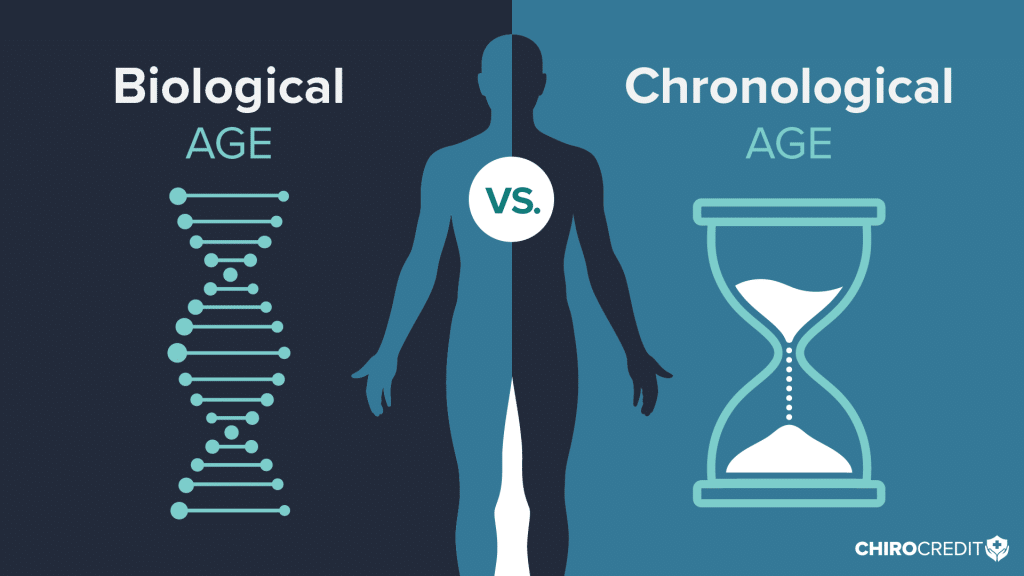
Chronological age and physiological age aren’t the same number, and patients already sense it. They’ve met the 55-year-old who moves like someone 15 years younger, and the 45-year-old who doesn’t. What most patients lack isn’t awareness of the gap — it’s a framework for understanding why it exists, and a clinician willing to walk them through the diet, movement, and stress factors that separate the two.
That gap is exactly where an anti-aging conversation earns its place in a chiropractic visit. It reframes the relationship from “fixing what hurts” to “extending what works” — a more durable connection with a patient, and a more resilient foundation for a practice, than episodic pain care alone.
Why This Belongs in a Chiropractic Practice, Specifically
DCs already occupy the part of a patient’s healthcare experience built around function, movement, and prevention rather than acute intervention. Adding a structured anti-aging component doesn’t require stepping outside that lane — it deepens it. It also differentiates a practice in a crowded local market, where most competitors are still positioned purely around pain relief and injury recovery.
For patients over 50 — a demographic that isn’t shrinking — a DC who can speak fluently about the physiology of aging, not just the mechanics of the spine, becomes a harder practitioner to leave.
Turning the Conversation Into a Credential
Talking informally with patients about healthy aging is a start. Building it into a documented, structured part of your practice is what turns the conversation into a service line — and gives you the clinical depth to back it up.
ChiroCredit’s Anti-Aging Certificate Program gives chiropractic doctors that foundation: 12 CE hours covering the physiology of aging and life-extension science, developed by Gary Italia, DC, PhD, with a full e-textbook, a 70-plus-page workbook, and a step-by-step guide for building a year-long anti-aging program into your practice. Like every ChiroCredit program, it’s backed by our PACE-approved, University of Bridgeport–sponsored curriculum — the same audit-proof foundation we’ve built continuing education on since 2001.
Full program details, CE hours, and pricing: ChiroCredit Anti-Aging Certificate Courses
References
- Italia, Gary. “Anti-Aging 201 Certificate Course: Introduction and Sections 1–4.” ChiroCredit.com. Accessed [10/5/2026]. https://www.chirocredit.com/specialty-pages/anti-aging.php. Primary source for this article; concepts on optimal vs. adequate nutrition, controllable factors in aging, life expectancy vs. life span, and “real age” vs. chronological age are drawn from and paraphrased against this course content.
- Kurk, Mitchell, and Morton Walker. Prescription for Long Life: Essential Remedies for Longevity. Avery Publishing Group, 1997. As referenced within ChiroCredit’s Anti-Aging 201 course material, in its discussion of long-lived population regions (e.g., Hunzaland, Vilcabamba) and shared diet and lifestyle factors.
- Roizen, Michael F. RealAge: Are You as Young as You Can Be? New York: Cliff Street Books/HarperCollins, 1999. As referenced within ChiroCredit’s Anti-Aging 201 course material, on the distinction between physiological (“real”) age and chronological age.
